
If you’ve struggled with chronic anxiety, fear of rejection, people-pleasing, or a persistent sense that you’re somehow “not enough”—despite being intelligent, capable, and self-aware—there may be an underlying pattern you haven’t yet discovered. It’s called Adult Emotional Dependency (AED), and understanding it can change everything.
✦ ✦ ✦
What Is Adult Emotional Dependency (AED)?
Adult Emotional Dependency (AED) describes a developmental pattern in which emotional self-reliance does not fully consolidate after adolescence.
Instead of feeling internally grounded, adults with AED tend to rely on external reassurance, approval, or emotional regulation through others. This creates anxiety, instability in relationships, people-pleasing behaviors, fear of abandonment, and chronic self-doubt.
AED is not a diagnosis and not a personality flaw. It is a functional pattern—a hard-coded, survival-based emotional program that was biologically designed to operate only during childhood. When it continues into adulthood, the consequences can be profound.
“AED is one of the primary root causes of chronic anxiety. The relief many people feel comes from realizing that their struggles are not personal failures, but the result of a developmental skill that was never completed.”
How AED Commonly Shows Up
People experiencing Adult Emotional Dependency often recognize patterns such as:
😰Relationship anxiety and reassurance-seeking — needing constant validation from partners
💔Fear of rejection or abandonment — disproportionate fear of losing relationships
🌊Difficulty self-soothing — struggling to feel emotionally settled without external support
🎭Over-functioning or people-pleasing — sacrificing your needs to gain approval
🧩Loss of clarity under pressure — confusion and self-doubt when emotionally stressed
👶Feeling “like a child in adult situations” — sensing something fundamental is missing
These patterns are often confusing because insight alone does not resolve them. You can understand why you feel anxious and still feel anxious. This is because AED operates at a developmental and functional level, not just a cognitive one.
Do You Have Adult Emotional Dependency?
If you recognized yourself in these patterns, take this 5-minute clinical assessment to understand whether AED is affecting your life.
What This Assessment Reveals:
✓ Your personal AED score across 31 clinical indicators
✓ Analysis of protection, love, and validation dependency patterns
✓ How AED may be affecting your anxiety and relationships
✓ Personalized recommendations for your next steps
Takes 5 minutes • Instant results • 100% confidential
The Full Spectrum of AED Symptoms
The consequences of emotional dependency in adulthood extend across every area of life. Common symptoms include:
Fear-Based Patterns
• Fear of judgment
• Fear of rejection
• Fear of abandonment
• Generalized anxiety
• Social anxiety
• Performance anxiety
Emotional Patterns
• Chronic self-doubt and insecurity
• Feelings of inadequacy
• Emotional numbness or neediness
• Depression
• Feeling like a fraud or imposter
• Loss of identity
Behavioral Patterns
• Need for external validation and approval
• People-pleasing and over-giving
• Accepting mistreatment to receive affection
• Codependency in relationships
• Addictions (substances, behaviors, relationships)
• Procrastination and feeling overwhelmed
Because anxiety and fear consume enormous brain resources, AED also significantly impacts brainpower and mental performance—reducing clarity, creativity, and effectiveness in every area of life.
✦ ✦ ✦
AED Is Not Trauma
While difficult experiences can influence emotional patterns, AED is not the same as trauma.
AED develops when the natural transition from childhood emotional dependency to adult emotional self-reliance does not fully complete. This transition is expected to occur before puberty, typically around ages 11-12.
The transition requires active guidance from parents and educators who model emotional stability, provide appropriate autonomy, and teach children how to meet their own emotional needs. When this guidance is missing or inconsistent, emotional dependency remains active beyond its intended developmental window.
This explains why many people with AED had “normal” childhoods—no obvious trauma, loving parents, stable homes. The issue isn’t what happened; it’s what didn’t happen: the completion of a natural developmental process.
Emotional Dependency: Childhood vs. Adulthood
Emotional dependency is normal and necessary in childhood. Children depend on caregivers for safety, guidance, and emotional regulation. This is biologically hardwired to ensure survival and healthy development.
Emotional Dependency uses powerful emotions to compel children to seek:
✓ Safety — seeking protection from adults
✓ Mental development — seeking leadership, validation, and guidance
✓ Emotional fulfillment — seeking love and care
As development progresses, the nervous system and mind are meant to internalize these functions. When this internalization does not occur, dependency remains externally oriented—creating AED.
The issue is not dependency itself, but dependency that never learned to mature.
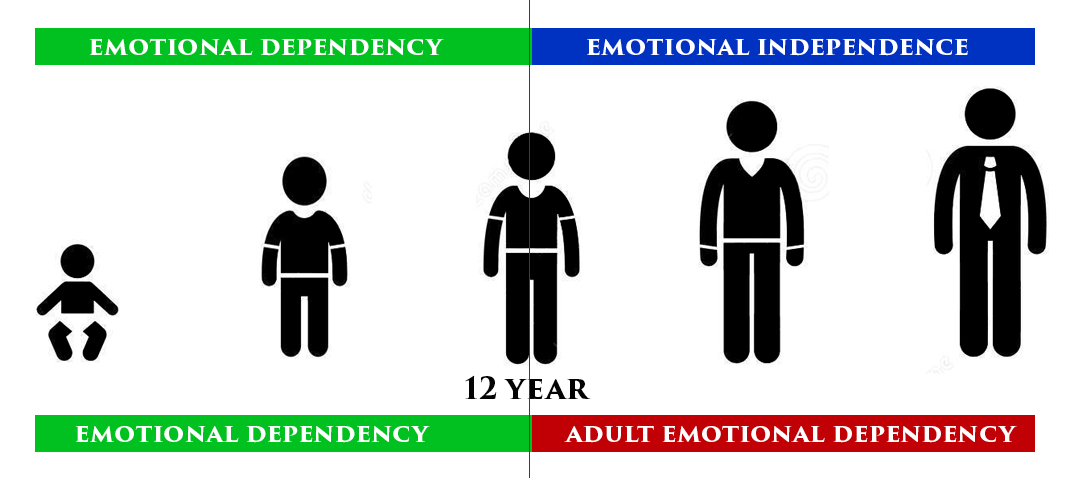
“We are born with the tools needed to become emotionally mature and self-reliant. During childhood these tools remain dormant, causing us to be dependent. As we approach puberty, our natural need for self-leadership awakens—but without proper models, the transition fails.”
Why Traditional Approaches Often Fail
Many people with AED have tried therapy, self-help books, meditation, and various healing modalities—yet the core pattern persists. Why?
Because most approaches focus on symptoms rather than root causes. They may help manage anxiety without addressing why the mind generates it. They may provide coping strategies without developing the internal capacity that makes coping unnecessary.
As explored in The Brain is Hardware, The Mind is Software, the mind operates according to its programming. If the dependency program was never updated, it continues running—regardless of how much insight or awareness you develop.
This is why the solution isn’t more analysis or emotional processing. It’s completing the developmental transition that was interrupted.
From Dependency to Self-Reliance
The resolution of AED does not come from suppressing emotions or becoming independent through force.
It comes from developing emotional self-reliance:
✓ The ability to regulate emotions internally
✓ The capacity to feel safe without constant reassurance
✓ Inner leadership during stress or uncertainty
✓ Relationships based on choice rather than need
This shift restores clarity, confidence, and emotional stability. The mind no longer needs to remain on alert because it no longer feels unprotected.
Understanding how to self-adopt your body and mind—providing yourself with the love, protection, and leadership that the mind requires—is central to this transformation.
Can AED Be Resolved?
Yes—because AED is a developmental pattern, not your identity. It is not a flaw or a disorder. It is a survival-based emotional program that simply continued past its intended expiration date.
Emotional self-reliance can be learned at any age once the mind is guided to assume its natural role of internal leadership. Many clients report significant improvement within just a few sessions, with full transformation typically occurring within 5-13 sessions.
The Bosurgi Mind Fitness Method® provides a structured framework that mimics the parental models needed for self-leadership. Combined with CognitiveOS Hypnosis®, this approach addresses AED at its functional root—not just its symptoms.
What Becomes Possible
When AED is resolved and emotional self-reliance is established, the transformation is profound:
✓ Dependency transforms into interdependency—relating through choice, not need
✓ Anxiety quiets as the mind no longer perceives constant threat
✓ Brainpower previously consumed by fear becomes available for high performance
✓ Relationships become balanced, fulfilling, and free of desperation
✓ Confidence emerges naturally from internal stability
✓ The ability to love unconditionally without fear becomes possible
The isolation created by dependency transforms into the freedom of genuine connection—where you can finally enjoy the world around you without anxiety or fear, acting by choice instead of need.
✦ ✦ ✦
Explore Mind Fitness Resources
✔ Adult Emotional Dependency (AED)
✔ Emotional Self-Reliance
✔ Brainpower & Mental Performance
✔ The Nature of Anxiety
✔ Trauma & PTSD
✔ Guided Meditations
✔ The Mind’s Manual Course
✔ Working With Luca
✦ ✦ ✦
Luca Bosurgi
Mind Fitness Coach & Cognitive Researcher
Discoverer of Adult Emotional Dependency (AED) and creator of the Bosurgi Mind Fitness Method® and CognitiveOS Hypnosis®. Over 30 years and 60,000+ sessions helping individuals resolve AED, develop emotional self-reliance, and reclaim their clarity, confidence, and freedom.
✦ ✦ ✦
Is AED Affecting Your Life?
If you recognize yourself in these patterns, a free 40-minute consultation can help you understand whether Adult Emotional Dependency is at the root of your struggles—and what resolution looks like.