Women, Stress & Relationships
The Hormone That’s Quietly Changing Your Body — and Your Marriage
Belly weight that won’t move. Skin and hair that aren’t yours anymore. A fuse that’s gone short with the person you love most. This isn’t you getting older or getting bitter. It’s an overactive nervous system, and the cortisol it keeps pouring out, rewriting a woman from the inside — and here’s how to turn it off.
She snapped at him about the dishwasher. He went quiet. By ten o’clock they were in separate rooms, each convinced the other one had changed. Neither of them had. Her nervous system had.
In more than 35 years and over 6,000 clients, this is one of the most common stories I hear from women: “My relationship is falling apart,” “I don’t recognize myself in the mirror,” “I’m exhausted and I can’t stop.” They sound like three different problems. They are one. A nervous system that has been stuck in survival mode for so long that it floods the body with cortisol around the clock — and cortisol, in a woman, reaches everything: her hormones, her weight, her skin, her sleep, her desire, her patience, and the way she sees her partner.
So let’s take it properly, from the top: what cortisol does to a woman’s body, why it hits women harder than men, how it dismantles a relationship, and what actually resets it.
A Nervous System Stuck in the “On” Position
Your nervous system has two settings. The sympathetic branch is the accelerator: it releases adrenaline and cortisol so you can fight, run, or stay alert. The parasympathetic branch is the brake: it slows the heart, digests food, repairs tissue, balances hormones, and lets you feel safe enough to rest, connect, and be touched.
The design assumes the threat ends. A lion appears, cortisol spikes, the lion leaves, cortisol falls. The problem is that modern threats don’t leave. A demanding job, a sick parent, money pressure, a child who is struggling, a phone that never stops — the subconscious mind reads these as one continuous lion. So cortisol stays up. Over months, the alarm center of the brain grows more sensitive, the part responsible for patience and perspective gets less say, and the brake pedal wears out.
The key reframe: you are not stressed because something is happening. You are stressed because your body has forgotten how to be anything else — and the mind has a reason, usually an old one, for keeping the alarm on.
The Three Real Causes of High Cortisol
Here is the question that unlocks everything: who is holding the alarm switch down? Your nervous system doesn’t decide on its own to stay in fight-or-flight. It takes its orders from the mind. And after three decades of looking under the hood of thousands of lives, I find the same three causes almost every time.
1. Adult Emotional Dependency — the biggest one. AED is a mind that never finished growing its own internal sense of safety and still outsources it to other people: their approval, their mood, their love, their opinion. At its root is the continuation into adulthood of a childhood feeling: “I am unsafe if I am unprotected.” In a child that feeling is vital — it keeps her close to the people who keep her alive. In an adult it is a curse — she is now fully capable of protecting herself, but her subconscious never got the memo, so it keeps searching for a protector and treats every sign of distance or disapproval as a threat to survival. A woman with AED is on duty every waking minute — reading faces, anticipating needs, smoothing things over, avoiding disappointment — because to her subconscious, losing approval feels like losing survival. That is a permanent, low-grade fight-or-flight. The cortisol never gets permission to fall, because the source of safety can be withdrawn at any moment. In my experience, AED is the single largest driver of chronic cortisol in the women I work with.
2. A mind you were never taught to manage. Nobody hands us a manual. Here is the piece almost everyone is missing: you are not your mind. The mind is a magnificent instrument, but it is an instrument — and you are its captain, its parent, its owner, its coach. Most women were never taught this, so they live inside the mind instead of in charge of it: every worry is obeyed, every fear is believed, every pressure is handled by force — pushing harder, worrying longer, sleeping less. A mind with no captain has no one to tell it how to process stress peacefully, how to prioritize, decide, set a boundary, let something go, or refuel. Left to run itself, it turns the ordinary stress of life into a lion.
3. Unresolved trauma. Trauma — the big kind, or the small repeated kind: a critical parent, a betrayal, a frightening childhood, an earlier relationship that hurt — is filed by the subconscious as still open. And an open file keeps the guard posted. The result is a defensive reaction fired at everyday situations that carry no real danger: a partner’s tone, a text left unanswered, a plan changed at the last minute. The body responds to a memory while she believes she is responding to him.
Put simply: a dependent mind keeps the alarm on to protect its supply of approval; a mind with no captain keeps it on because no one has told it how else to cope; a wounded mind keeps it on because the old danger was never declared over. All three run through the same pipe — cortisol — and all three land on the same place: her body, and her relationship.
What Chronic Cortisol Does to a Woman’s Body and Appearance
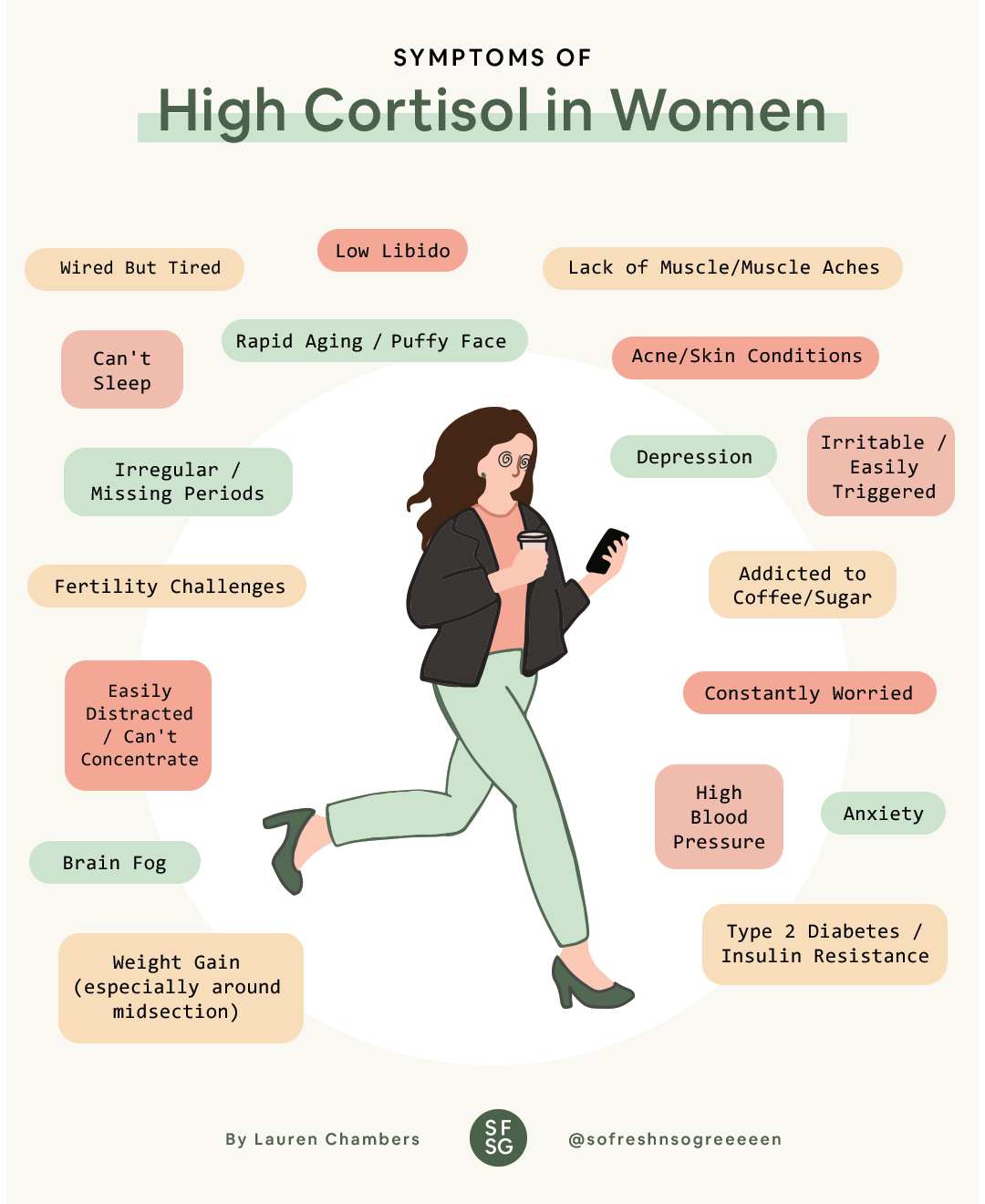
Many of the women who come to see me have already been to a doctor about one of these, without anyone connecting them. Together, they are the signature of a system running hot.
The cortisol belly and the rounder face. Cortisol tells the body to store fat for an emergency, and it stores it centrally — around the abdomen, the upper back, and the face. This fat does not respond to the usual diet, because the body is holding it on purpose. Women describe it as “a belly that appeared out of nowhere” and a face that looks puffier in photos than it feels.
Skin that ages faster. Sustained cortisol breaks down collagen and elastin, thins the skin, and weakens its moisture barrier. The result is dryness, dullness, easy bruising, slower healing, more fine lines, and in some women stretch marks or adult acne, because cortisol also pushes the skin to produce more oil. The “tired look” people comment on is often cortisol, not sleep alone.
Hair in the wrong places. Cortisol disrupts the hair growth cycle, so scalp hair thins and sheds, while its effect on androgen activity can bring unwanted hair to the chin, jaw, or chest. Few things undermine a woman’s confidence with her partner faster than this.
Cycles that go haywire. Cortisol is made from the same raw material as progesterone and estrogen. In survival mode the body prioritizes cortisol and starves the rest: irregular or missed periods, heavier bleeding, worse PMS, fertility struggles, and a perimenopause that feels like a cliff instead of a slope.
Wired at night, dead in the morning. Cortisol should peak at dawn and fall by evening. In a dysregulated system it does the opposite, so she lies awake replaying the day and wakes exhausted — the “tired-and-wired” pattern. Poor sleep then removes the last layer of emotional buffer.
Brain fog and mood swings. Elevated cortisol impairs memory and focus and heightens anxiety and irritability. She forgets appointments, loses her words, and feels intense emotions she can’t explain to herself, let alone to him.
Why Women Pay a Higher Price Than Men
Men and women both produce cortisol. Women carry three extra burdens.
Hormones compete. As above, every unit of cortisol is produced at the expense of the hormones that keep a woman’s skin, cycle, mood, and libido in balance. A man’s stress mostly costs him energy. A woman’s stress costs her hormones.
Oxytocin gets drowned out. Oxytocin is the bonding hormone: it is what makes a hug feel good and a partner feel like a safe place. Cortisol and oxytocin work against each other. When cortisol dominates, the same touch that used to soothe becomes irritating, and closeness starts to feel like one more demand.
Women are the barometer of the relationship. This is not my opinion; it is what the research shows. In a well-known study of newlyweds, wives’ cortisol rose far more than husbands’ when they recounted the difficult parts of their marriage, and the women whose cortisol climbed were more than twice as likely to be divorced a decade later. Later studies found that wives who felt they had less power in the marriage failed to recover their cortisol to baseline after an argument, while their husbands did. In other words: her body keeps the score of the relationship, long after the conversation is over.
Six Ways Excess Cortisol Dismantles a Relationship
1. Everything sounds like criticism. A hypersensitive alarm center scans for threat. “Did you call the plumber?” lands as “You never do anything.” She is not being unreasonable. Her brain is doing exactly what months of alarm trained it to do.
2. The fuse gets short. Cortisol narrows attention and strips patience. A tone of voice, dishes in the sink, a late reply — each triggers a reaction sized for a real emergency. Then comes guilt, which adds stress, which shortens the fuse further.
3. Desire disappears. A body in survival mode shuts down reproduction and pleasure as luxuries. Add fatigue, cycle pain, and a woman who no longer likes what she sees in the mirror, and intimacy collapses. Low libido in a stressed woman is not a sign she has stopped loving her partner. It is a sign her body does not feel safe enough to open.
4. She pushes, he withdraws. Research on couples describes a classic pattern: the wife demands, the husband shuts down — and it is the wife’s cortisol, not the husband’s, that spikes in that loop. Other women do the opposite and go quiet, feel “touched out,” need space. Both are the same nervous system looking for relief, and both read to a partner as rejection.
5. The shared life shrinks. Chronic fatigue and low mood mean date nights get cancelled, family outings get skipped, friends stop being invited. The partner feels neglected. She feels judged for not having the energy. The distance grows without a single argument.
6. The partner becomes the enemy. This is the one that ends relationships. When the alarm is always on, the brain needs a cause. The closest person becomes the explanation: “I am like this because of him.” Sometimes that is true. Far more often the stress came from everywhere, and he is simply the one standing in the room when it overflows.
What This Is Not — and Why Talking About the Fights Doesn’t Fix It
It is not a character flaw. A woman with an overactive nervous system is not “too emotional,” “difficult,” or “impossible to please.” She is running a system built for short emergencies that has been asked to run a marathon.
It is not a bad partner. Couples spend years dissecting who said what, when the real issue is biochemical. Analyzing the arguments does not lower cortisol. In many cases it raises it.
And it is not fixed by soothing the body. Breathing exercises, walks, supplements, a cold plunge — good tools, all of them. But they calm the body’s alarm for an hour. They don’t speak to the part of the mind holding the switch. So the system climbs right back to its familiar setting, because the reasons it was set high are all still filed as open.
The honest rule: you cannot reason a smoke detector into silence, and you cannot diet, moisturize, or date-night your way out of a nervous system that believes it is in danger. The alarm has to be switched off where it lives — in the subconscious mind.
What Actually Resets a Woman’s Nervous System
A real reset has three parts, in this order.
First, find what the alarm is actually guarding. Not the surface stress — the underneath: which of the three causes is running the show. Is it dependency on approval, a mind with no tools for pressure, an old wound still filed as open — or, as is usual, all three in a particular mix? Three decades of seeing the same handful of causes under thousands of different lives makes them fast to find in yours.
Second, settle those causes — don’t just understand them. Insight alone changes very little; you can know exactly why you’re on edge and still be on edge. This is where hypnosis earns its place: it works directly with the subconscious layer where the alarm settings live, using my CognitiveOS Hypnosis® method to close what was left open and retire the guard, case by case. In a relaxed, fully awake state, the mind learns that the emergency is over — and the body follows.
Third, give the mind a structure to run on. A nervous system stays regulated when the mind managing it is fulfilled and well-run. That is why the work is more than hypnosis: it is mind and life coaching too, rebuilding how you process stress, set boundaries, make decisions, and refuel, so the calm you gain has somewhere solid to live. That is the whole logic of the Bosurgi Mind Fitness Method®: settle the causes once, then equip the mind so the problem has no way back in.
Women are often surprised by how physical the change is. When cortisol finally falls, sleep deepens, the cycle steadies, the skin and the belly begin to respond to what you do for them, and the fuse gets long. Their partners usually notice before they do — and, in my experience, the relationship that was “falling apart” turns out to have been waiting for her to come home to herself.
Recognize Yourself — or the Woman You Love?
Let’s Find What’s Keeping Your Alarm On
A free, private 45-minute conversation — in person in Spring Hill, Florida, or by Zoom anywhere in the world. I’ll tell you honestly what I see, and whether I can help.
Or call the office: (352) 675-2331 · 35+ years · 6,000+ people · 100+ five-star reviews
One Important Note
Severely elevated cortisol can have medical causes — Cushing’s syndrome, a pituitary or adrenal problem, or certain medications — and some of the symptoms above (rapid central weight gain, purple stretch marks, very easy bruising, high blood pressure, missed periods) deserve a blood test and a doctor’s eye first. Ruling out the physical is step zero, not a detour. And if you’re working with a therapist or physician, this work sits comfortably alongside their care, never in place of it.
Hypnosis and Mind Fitness coaching support personal growth and self-improvement and are not a substitute for medical or psychological care. Individual results vary.
Sources: Cleveland Clinic — Cortisol · American Psychological Association — wives as “barometers” of marital stress · Wives’ and Husbands’ Cortisol Reactivity to Couple Conflict (PMC) · Cortisol in Married Couples (PMC) · Newlywed Couples’ Marital Power and Cortisol Recovery (UMass) · Signs of high cortisol in women — skin and hair