

Adult Emotional Dependency (AED)
The Mind's Starving Behavior — And Why It Keeps Anxiety, Self-Doubt, and Emotional Struggles Active
AED is not a disorder or a flaw. It is a natural childhood survival program that every human is born with. The problem begins when it stays active into adulthood — because the mind's emotional foundation was never built.
Understanding AED Starts with a Simple Principle
To understand Adult Emotional Dependency, it helps to think about something we all already understand: the body.
The Body Needs Nutrition
Your body needs proteins, vitamins, minerals, and water. When these are missing, the body activates hunger and thirst — survival signals that compel you to seek food externally.
This is normal and healthy. Seeking food externally is exactly what the body is designed to do.
The Mind Needs Emotional Foundations
Your mind needs emotional safety, self-trust, and inner stability. When these are missing, the mind activates its own survival signal — emotional dependency — which compels you to seek safety, love, and validation externally.
In childhood, this is normal and essential. In adulthood, it becomes the source of anxiety, fear, and emotional struggle.
Research support: Ryan & Deci's Self-Determination Theory identifies the same three psychological needs — safety, relatedness, and autonomy — as the universal foundations of human wellbeing. When chronically unmet internally, the mind activates compensatory seeking behavior in exactly the way hunger drives food-seeking.
That survival signal — seeking emotional regulation externally as an adult — is Adult Emotional Dependency. It is the mind's starving behavior: a sign that its basic emotional needs have never been fulfilled.
What Is Adult Emotional Dependency?
Every child is born with a biological survival program written into their DNA. This program makes the child emotionally dependent on caregivers for three essential things: protection, love, and guidance.
This is not a flaw — it is how nature keeps children safe. The program is designed to terminate around age 11–12, just before puberty, when the young person develops the ability to meet these emotional needs from within. However, when this transition doesn't happen, the program stays active — and the adult continues operating with the emotional dependency of a child.
The 3 Core Functions of Childhood Emotional Dependency
1. 🛡️ Protection Need
This function compels children to rely on parents for protection. It makes them feel unsafe whenever they are unprotected — which is appropriate for a child.
When active in adults: Creates constant anxiety, hypervigilance, threat-scanning, and an inability to feel safe — even when physically safe.
Polyvagal Theory (Porges, 2011): the nervous system cannot self-regulate while the threat-detection system is on continuous alert. When the protection need is not met internally, the nervous system defaults to hypervigilance as its only available safety strategy.
2. ❤️ Love as a Need
This function compels children to seek love as a survival need. For a developing mind, love is not optional — it is essential for growth and emotional development.
When active in adults: Creates fear of abandonment, relationship anxiety, neediness, codependency, and emotional pain when feeling unloved.
Attachment theory (Bowlby, 1969; Ainsworth, 1978): the drive to seek proximity and love from caregivers is a primary biological survival system — not a secondary preference. When this system is not resolved into secure internal attachment, it continues operating in adults as fear-driven relational behaviour. Vrtička & Vuilleumier (2012) confirmed the distinct neural signatures of this unresolved pattern in adult brains.
3. 👀 Validation & Guidance Need
This function compels children to look up to adults, copy their behaviors, and seek their approval. This is how children learn to navigate the world.
When active in adults: Creates people-pleasing, fear of judgment, chronic self-doubt, and an inability to make decisions independently.
SDT research (Deci & Ryan, 2000) identifies autonomy — the capacity to act from internal guidance rather than external direction — as a core psychological need. When this need is not developed internally, controlled motivation (behaviour driven by external approval and fear of judgment) replaces autonomous motivation and produces the chronic self-doubt and people-pleasing described here.
What Happens When This Program Doesn't Terminate
When the mind's emotional foundations are never built, the dependency program has no reason to shut down. It continues into adulthood.
Your adult mind then experiences the same three compulsions a child's does — the need for external protection, external love, and external validation — but now in an adult context where they create anxiety, emotional pain, and relationship struggles.
This is Adult Emotional Dependency. And it will remain active until the emotional foundation is built — regardless of how many other solutions are applied.
Research context: Siegel's interpersonal neurobiology (1999, 2012) demonstrates that the prefrontal cortex — responsible for self-regulation, internal leadership, and autonomous decision-making — achieves its primary integration during late childhood and adolescence. When the environmental and relational conditions for this integration are absent, the regulatory development does not complete — leaving the subcortical survival systems dominant into adulthood.
AED Is Biological, Not Caused by Bad Parenting or Trauma
This is one of the most important things to understand about Adult Emotional Dependency — and the one that removes the most shame.
🧬 AED Is Hard-Coded into Every Child's DNA
Adult Emotional Dependency is not caused by trauma. It is not caused by bad parenting.
Nature builds this survival program into every child. It is essential — without it, a child would have no drive to stay close to caregivers and would not survive.
The program is designed to terminate around age 11–12, when the young person develops the capacity for emotional self-reliance — the ability to feel safe, loved, and guided from within.
When that capacity doesn't develop, the program simply stays on. Not because something went wrong — but because the conditions for it to shut down were never met.
Research context: Evolutionary developmental biology (Trivers, 1974; Bowlby, 1969) confirms that infant dependency on caregivers is a hard-wired survival mechanism conserved across all mammalian species. The biological termination of this program depends on the development of internal regulatory capacity — a process that is dependent on relational and environmental input, not simply on time passing.
30% of People with AED Had Perfect Childhoods
In over 30 years of clinical work, approximately 30% of clients with active AED had loving parents, safe environments, no abuse, and no neglect.
They still developed anxiety, self-doubt, and emotional dependency — because the transition to emotional self-reliance simply didn't happen.
This confirms that AED is a biological program that didn't terminate on schedule — not a wound caused by life events.
Research context: Developmental psychology (Kagan, 2010; Caspi & Moffitt, 2006) confirms that individual differences in regulatory development arise from a combination of temperament, neurological timing, and the specific conditions available for internal skill-building — not from adversity alone. Emotional dependency can persist in completely supportive environments if the specific developmental scaffolding for self-reliance is not provided.
Can Trauma Make AED Worse?
Yes. Traumatic experiences can reinforce an already-active dependency program and make its effects more intense.
However, trauma does not cause AED. The program was already running — trauma simply strengthens the patterns that were already there.
This is why approaches that focus only on processing traumatic memories often don't produce lasting change. If the underlying dependency program is still active, the mind continues generating the same emotional responses — regardless of how many memories are processed.
Research support: van der Kolk (The Body Keeps the Score, 2014) and Levine (Somatic Experiencing, 2010) both document that trauma is stored at the subcortical and somatic level — below the reach of verbal or memory-based processing. When the nervous system's baseline regulatory capacity (AED) is already compromised, trauma compounds the dysregulation rather than creating it from scratch.
How Adult Emotional Dependency Shows Up in Everyday Life
Most people experiencing these patterns don't realize they all share the same root: a childhood dependency program that is still active. They are not character flaws — they are the mind's survival responses when its emotional foundation is missing.
🛡️ Protection-Based Patterns
• Feeling unsafe even when physically safe
• Chronic anxiety and constant worry
• Difficulty calming yourself down
• Freeze responses when overwhelmed
Porges' Polyvagal Theory: without internal safety, the nervous system locks into defensive states — fight, flight, or freeze — as its only available strategy.
❤️ Love-Based Patterns
• Experiencing love as a desperate need
• Fear of abandonment or rejection
• Relationship anxiety and codependency
• Emotional pain when feeling unloved
Vrtička & Vuilleumier (2012): unresolved attachment dependency produces measurably heightened neural reactivity to social rejection — the brain literally processes relational threat as physical danger.
👀 Validation-Based Patterns
• Seeking constant external approval
• People-pleasing as a way of life
• Difficulty making decisions on your own
• Fear of judgment and criticism
SDT research: when autonomy is chronically unmet, external regulation (seeking approval, fearing judgment) replaces internal guidance — producing exactly this cluster of validation-seeking behaviours.
🎭 General Patterns
• Feeling "like a child" in adult situations
• Losing clarity under emotional pressure
• Self-doubt despite being capable
• Emotional numbness or overwhelm
These patterns are confusing because understanding them does not make them stop.
They are driven by a biological program, not by a lack of insight — and they require building the emotional foundation that was never put in place, not more analysis.
Kahneman's dual-process theory explains this precisely: the dependency program operates in System 1 — fast, automatic, subcortical — and is not subject to override by System 2 rational understanding. Insight alone cannot deactivate a survival program; the programme requires its own conditions to be met.
How Strong Is Your Emotional Foundation?
This free 5-minute assessment measures 31 indicators of Adult Emotional Dependency — helping you see where your emotional foundation stands and which areas could benefit most from this work.
What This Assessment Reveals:
Takes 5 minutes. Based on 30+ years of clinical work. Results are instant, confidential, and free.
Start Assessment
See where your emotional foundation stands
Take the Free Assessment →No signup required • Instant results
Why Adult Emotional Dependency Persists
The dependency program can only terminate when the mind develops emotional self-reliance. Without it, the program has no reason to shut down — no matter how old you are.
The Transition from Dependency to Self-Reliance
The dependency program can only terminate when the young person develops three capacities from within:
✓ Internal Safety: The ability to feel safe from within, without needing external protection
✓ Love as a Choice: Experiencing love as a gift to share, not a desperate survival need
✓ Internal Leadership: Making decisions from your own center, rather than seeking external validation
When these capacities develop, the biological program recognizes it is no longer needed — and it terminates naturally. The mind transitions from emotional dependency to emotional self-reliance.
This is not something you force. It is something you build — and the program responds on its own.
Research context: Bowlby's concept of the secure base, extended by Siegel (1999) and Fonagy et al. (mentalization theory, 2002), confirms that the transition from external to internal regulation is a learnable developmental achievement — not an automatic biological event. It requires specific conditions and, when those conditions are absent, the transition does not occur regardless of age.
Why This Transition Rarely Happens on Its Own
Most of the time, this transition doesn't happen — not because of bad parenting, but because of a simple gap: no one teaches emotional self-reliance.
Parents and educators usually cannot provide this education because they were never taught it themselves. They are often operating from their own active dependency programs.
This is why AED is so widespread — and why most people don't even know it's there. They just know that something feels off, that they struggle with anxiety or self-doubt or relationship problems, and that nothing they've tried has fully fixed it.
Research support: Intergenerational transmission of attachment patterns (van IJzendoorn, 1995; Fonagy, 2002) demonstrates that unresolved dependency is passed from parent to child not through deliberate teaching, but through the relational environment parents create — which reflects their own unresolved patterns. This explains the generational nature of AED without attributing blame.
Why Other Approaches Often Don't Produce Lasting Change
If you've tried therapy, self-help, or other methods and still feel stuck — it's not because those approaches are bad. It's because they were applied without the foundation in place.
Think of It This Way:
If someone is starving and malnourished, you can give them the best fitness program in the world — but their body won't respond well because the basic nutritional needs aren't met. The solution isn't a better fitness program. It's food first, then fitness.
The same applies to the mind. You can process memories, learn coping skills, practice mindfulness, and work on your thoughts — but if the mind's basic emotional needs are still unmet, it will continue operating from dependency. The solution isn't a better therapy. It's building the emotional foundation first — then everything else can work.
Research convergence: Polyvagal Theory (Porges), SDT (Ryan & Deci), and somatic trauma research (Levine, van der Kolk) independently arrive at the same conclusion — higher-order therapeutic interventions cannot take root until the nervous system's baseline regulatory needs are met. Foundation first is not a philosophical preference; it is what the neuroscience requires.
This is why emotional self-reliance is the starting point — not one option among many, but the foundation that makes everything else possible. When the foundation is built, AED naturally resolves, and the mind is free to heal, grow, and perform at its best.
Watch: Understanding Adult Emotional Dependency
These videos explain how AED works, why it keeps emotional struggles active, and how emotional self-reliance resolves it.
Can Adult Emotional Dependency Be Resolved?
Yes — completely. And when it does, the anxiety, self-doubt, and emotional patterns it was generating naturally fall away.
✓ Complete Resolution Is Possible — At Any Age
Adult Emotional Dependency is not your identity. It is not a disorder, a flaw, or a permanent condition.
It is a biological survival program that stayed active because the conditions for it to shut down were never met.
When you build the emotional foundation — when you develop genuine emotional self-reliance — the program recognizes it is no longer needed, and it deactivates. This can happen at any age.
Research support: Merzenich (2013) and Doidge (The Brain That Changes Itself, 2007) document extensive evidence that the brain retains the capacity to form new regulatory pathways throughout adult life. The developmental process that was interrupted in childhood can be completed in adulthood through structured, guided practice that engages the same neurological mechanisms.
How Resolution Works
The process is the same one that should have happened naturally before puberty — building the three core capacities that allow the dependency program to terminate:
✓ Internal safety — feeling safe from within
✓ Love as a choice — not a survival need
✓ Internal leadership — making decisions from your own center
This is not about suppression, coping, or managing symptoms. It is about completing the developmental transition that was never completed — so that your mind can finally operate from its own emotional foundation.
Using CognitiveOS Hypnosis®, this work happens at the subconscious level — where the dependency patterns are stored — helping the mind build emotional self-reliance efficiently and permanently.
Research support: A 2024 IFS therapy clinical trial — which similarly addresses the internal emotional architecture rather than surface symptoms — reported a 92% PTSD remission rate, directly supporting the effectiveness of working at the level of emotional structure. Mount Sinai (PNAS, 2025) and Harvard MGH research confirms that structured guided imagery produces measurable neurological change: reduced amygdala reactivity and strengthened prefrontal regulation — the precise biological shifts that allow AED to resolve.
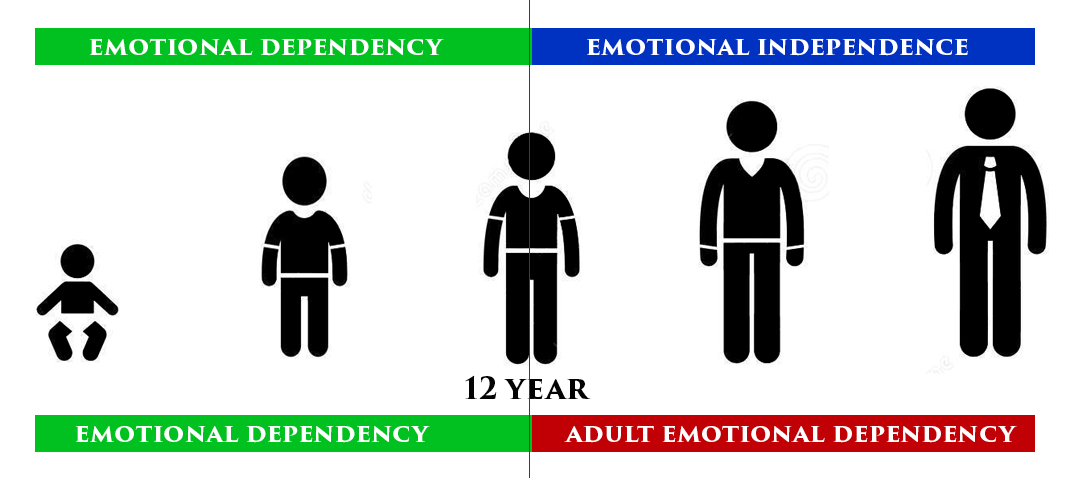
The developmental timeline of emotional dependency and the transition to emotional self-reliance
From Adult Emotional Dependency to Emotional Self-Reliance
Building emotional self-reliance is both the solution to AED and the foundation for lasting mental health.
What Emotional Self-Reliance Includes:
✓ The ability to regulate your emotions from within
✓ Feeling safe without needing external reassurance
✓ Inner leadership during stress and challenges
✓ Relationships based on choice, not emotional survival
What Happens When AED Resolves:
✓ Anxiety and constant worry naturally fade
✓ Emotional triggers lose their power
✓ Inner calm and clarity replace mental noise
✓ Freedom from people-pleasing, self-doubt, and fear of rejection
This Shift Does Not Require Force
You don't need to fight your emotions or "power through" your struggles.
When the emotional foundation is built, the dependency program shuts down on its own — just as hunger stops when you eat. The need is met.
This is precisely the mechanism SDT describes as "need satisfaction" — when basic psychological needs are genuinely met internally, the compensatory behaviors driven by their absence cease naturally, without effort or suppression. The programme terminates because its function has been fulfilled.
Ready to Build Your Emotional Foundation?
Book a free consultation to explore how building emotional self-reliance can resolve Adult Emotional Dependency and the patterns it creates.
Learn More
Explore these pages to understand emotional self-reliance, how the mind works, and the path to lasting emotional freedom.
Emotional Self-Reliance
The foundation of all lasting mental health — and the key to resolving AED.